
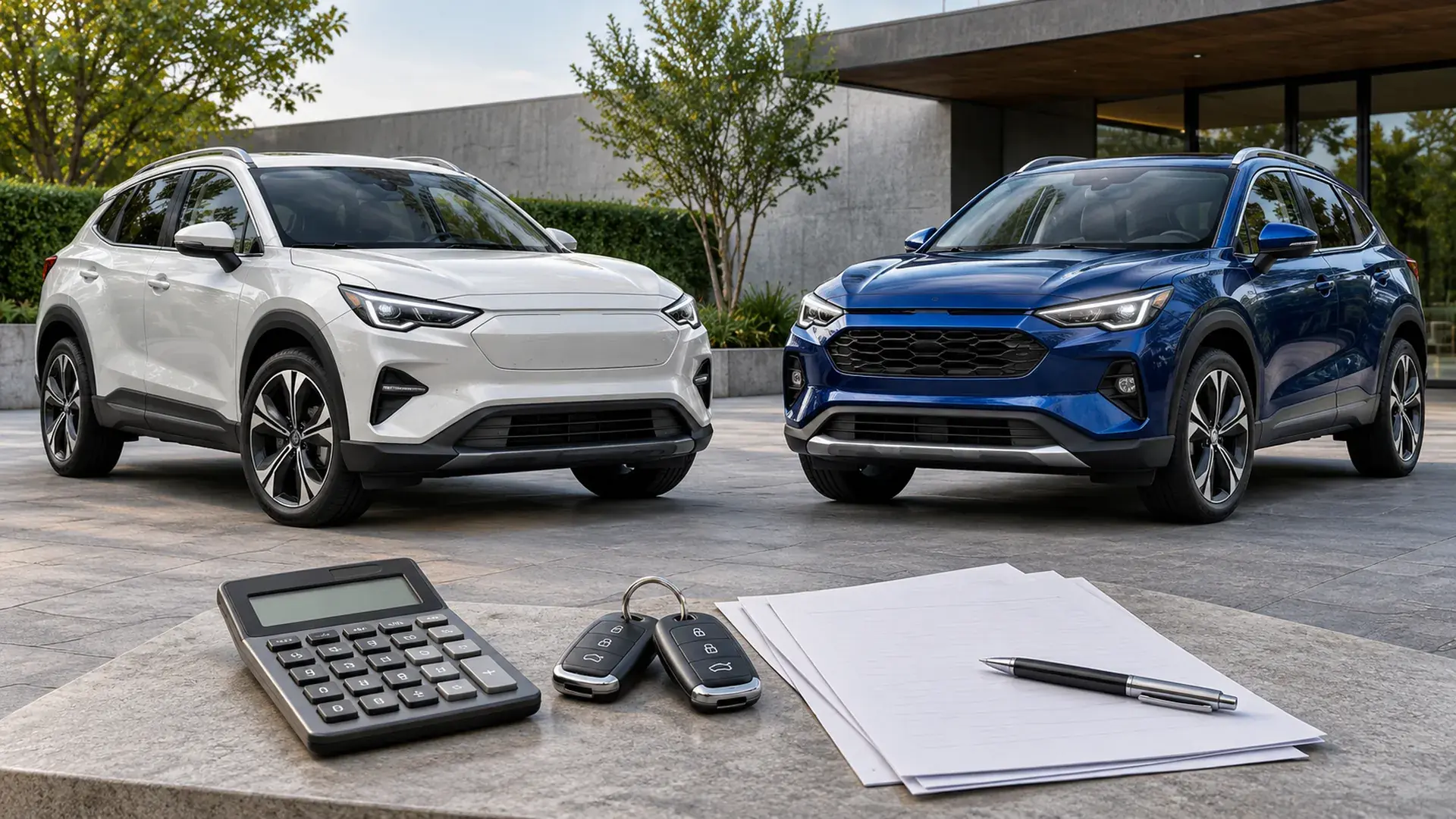
Electric cars can cost less to power, but that doesn’t always make them cheaper to own. In AAA’s 2026 ownership-cost analysis, conventional hybrids had lower total costs than electric vehicles across the four vehicle classes compared. That finding doesn’t mean a hybrid is the better deal for every driver.
The real electric vs hybrid cost of ownership depends on much more than gas or electricity bills. Purchase price, depreciation, insurance, financing, maintenance, and whether you can charge at home all affect the five-year total. This guide breaks down verified 2026 data, compares a Chevrolet Equinox EV with a Toyota RAV4 Hybrid for energy costs, and shows how to evaluate the numbers for your own mileage and charging habits—without confusing lower running costs with lower overall costs.
Electric vs Hybrid Cars: What's the Difference?
Electric and hybrid cars both use electric motors, but they get their power in different ways. That difference affects everything from where you refuel to how much you spend on maintenance.
How Electric Cars Work
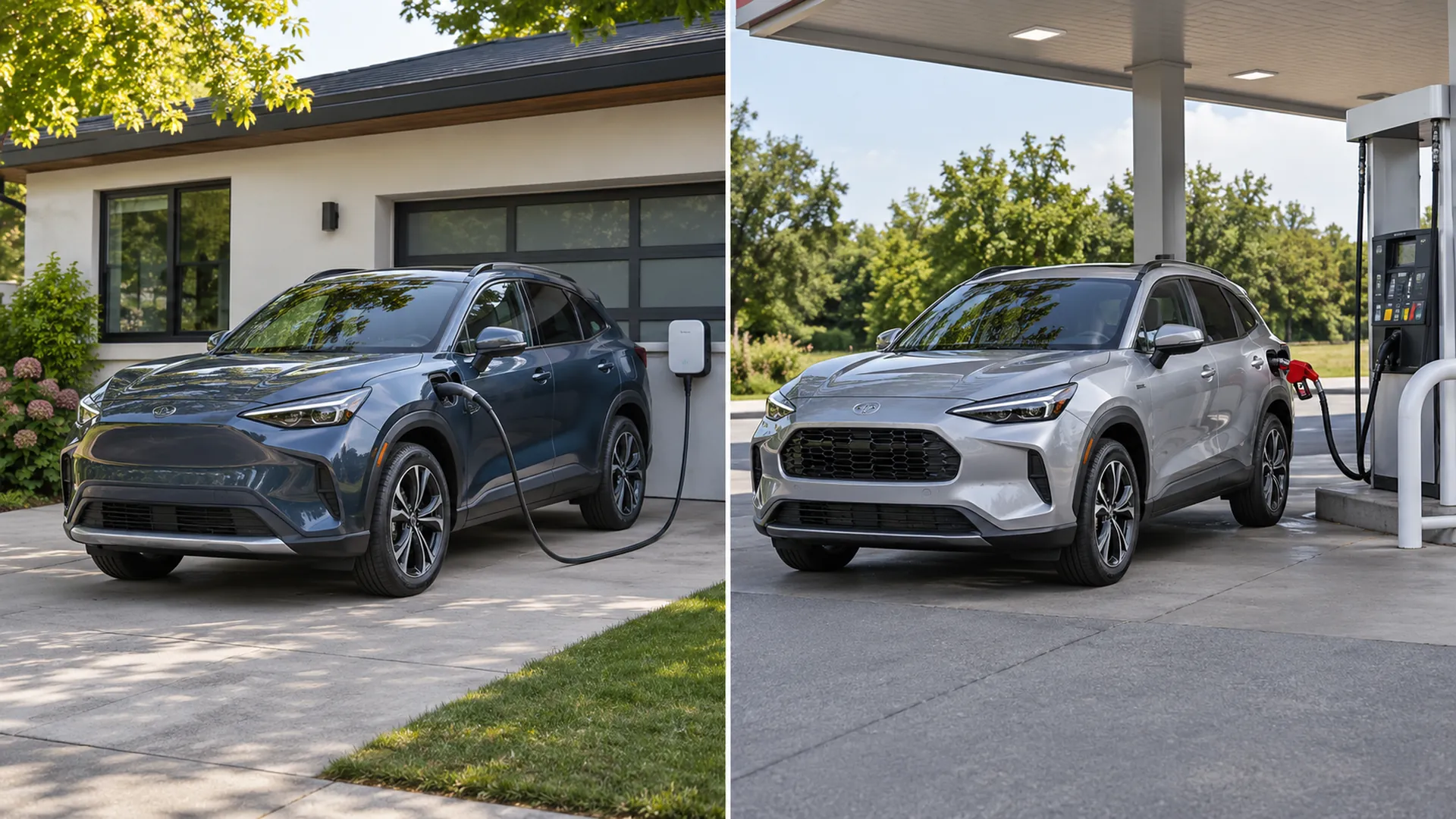
A battery-electric vehicle (BEV), usually called an electric car or EV, runs entirely on electricity stored in a rechargeable battery. It doesn't have a gasoline engine, so you need an external power source to charge it.
The Chevrolet Equinox EV and Hyundai Ioniq 5 are examples of fully electric vehicles.
Because EVs don't burn gasoline, their owners avoid fuel purchases and routine engine services such as oil changes. They still have expenses, though, including electricity, insurance, tires, and occasional repairs.
How Conventional Hybrid Cars Work
A conventional hybrid electric vehicle (HEV) uses both a gasoline engine and an electric motor. Its battery recharges through regenerative braking and the vehicle's own systems, so there's no need to plug it in.
The Toyota RAV4 Hybrid is one example.
Hybrids can use less gasoline than comparable conventional vehicles, especially in city driving, where electric assistance and regenerative braking can make a noticeable difference.
What about plug-in hybrids?
Plug-in hybrid electric vehicles (PHEVs) sit somewhere between these two options. They have larger rechargeable batteries and can travel a limited distance using electricity before relying more heavily on their gasoline engines.
The U.S. Department of Energy explains how these powertrains differ.
For this comparison, we're focusing on fully electric vehicles and conventional, non-plug-in hybrids. Plug-in hybrids need their own calculations because their fuel costs depend heavily on how regularly they're charged.
How Much Does It Really Cost to Own an EV vs a Hybrid?
The sticker price is the number most buyers notice first. But it's rarely the best way to judge what a vehicle will actually cost.
A cheaper car might lose more value over time. A more expensive one might save money through lower energy and maintenance costs. Insurance, financing, and taxes can shift the balance further.
That's why the five-year total cost of ownership (TCO) matters more than the purchase price alone.
What Counts Toward Five-Year Total Cost of Ownership?
A proper comparison should account for the money you spend while owning the vehicle, along with the value you expect to recover when you sell it.
Cost factor | What it includes |
|---|---|
Depreciation | The difference between the vehicle's purchase price and its estimated resale value |
Financing | Loan interest and applicable financing charges |
Gasoline or electricity | Energy consumed throughout the ownership period |
Insurance | Premiums for comparable coverage |
Maintenance and repairs | Routine servicing, repairs, and replacement tires |
Taxes and registration | Purchase taxes, licensing, and recurring vehicle fees |
Home charging setup | Charging equipment, electrical work, and installation, if needed |
The AAA Your Driving Costs study follows a similar approach, accounting for major expenses such as depreciation, financing, fuel, insurance, maintenance, repairs, tires, and government fees.
How to Calculate Five-Year Ownership Costs
You can estimate five-year ownership costs using this formula:
Five-year ownership cost = Depreciation + Financing costs + Energy costs + Insurance + Maintenance and repairs + Taxes and registration + Charging setup costs − Eligible incentives not already included in the purchase price
Depreciation is worth understanding because it's often one of the largest expenses.
Suppose you buy a car for $35,000 and sell it five years later for $20,000. You've lost $15,000 in vehicle value.
That $15,000 is your depreciation expense.
These are hypothetical numbers used to explain the calculation, not a prediction for any specific model.
One important detail: don't add the full $35,000 purchase price again after accounting for depreciation. That would count part of the same expense twice.
The same principle applies to financing. If depreciation already reflects the vehicle's purchase cost, include loan interest and relevant financing charges rather than adding loan principal again.
And if a rebate has already reduced the purchase price used in your calculation, don't subtract it a second time.
Electric vs Hybrid Ownership Costs in 2026: What AAA Found
AAA's September 2026 Your Driving Costs research offers a useful starting point because it looks beyond fuel and electricity bills.
The study estimates vehicle ownership costs over five years and 75,000 miles, equivalent to 15,000 miles annually.
Electric vs Hybrid Annual Ownership Costs
Vehicle category | Electric vehicle | Conventional hybrid | Hybrid annual savings |
|---|---|---|---|
Medium sedan | $13,662 | $10,204 | $3,458 |
Compact SUV | $11,888 | $11,201 | $687 |
Medium SUV | $14,332 | $13,698 | $634 |
Pickup truck | $17,414 | $16,117 | $1,297 |
Source: AAA 2026 Your Driving Costs, page 3. Figures are annualized ownership-cost estimates for selected vehicle models driven 15,000 miles per year.
Conventional hybrids came out cheaper in all four categories.
But look at how much the difference changes between vehicle types.
For compact SUVs, the hybrid advantage was $687 per year. For medium sedans, it was $3,458.
AAA also estimated ownership costs of approximately $0.793 per mile for its selected electric compact SUVs and $0.747 per mile for the hybrids.
Those figures include depreciation and other ownership expenses, not just the cost of moving the car down the road.
It's also important to understand what AAA compared. These are averages for selected vehicles within each category, not every model on sale in 2026. The cars don't necessarily have identical features or equipment.
Why Did Hybrids Cost Less Overall?
AAA's compact SUV breakdown makes the answer clearer.
Annual expense | Electric compact SUV | Hybrid compact SUV |
|---|---|---|
Gasoline or electricity | $771 | $1,731 |
Maintenance, repairs, and tires | $1,402 | $1,506 |
Depreciation | $5,298 | $3,845 |
Full-coverage insurance | $2,277 | $2,294 |
Licensing, registration, and taxes | $931 | $739 |
Finance charges | $1,208 | $1,087 |
Total annual ownership cost | $11,888 | $11,201 |
Source: AAA's original 2026 ownership-cost tables. Individual rounded figures may not add up exactly to the published totals.
The electric SUVs saved about $960 per year on energy and another $104 on maintenance, repairs, and tires.
Those savings are meaningful. But they weren't enough.
The electric SUVs had $1,453 more in annual depreciation. Financing and government fees also added to their costs.
Interestingly, insurance was slightly cheaper for the EVs in this particular comparison. That doesn't mean electric cars always have lower insurance premiums, but it shows why broad assumptions can be misleading.
The bigger lesson is that lower running costs don't always lead to lower total ownership costs.
Real 2026 SUV Comparison: Chevrolet Equinox EV vs Toyota RAV4 Hybrid
National averages are helpful, but comparing actual vehicle specifications makes the numbers easier to understand.
Let's look at two compact SUVs sold in the United States:
2026 Chevrolet Equinox EV LT 1 FWD
2026 Toyota RAV4 Hybrid LE FWD
These vehicles are in a similar broad category, although their equipment and features aren't identical.
This example compares published prices and energy expenses. It isn't a complete five-year ownership-cost comparison between the two models.
Purchase Price and Vehicle Efficiency
Specification | Chevrolet Equinox EV | Toyota RAV4 Hybrid |
|---|---|---|
Model year | 2026 | 2026 |
Selected trim | LT 1 FWD | LE FWD |
Powertrain | Fully electric | Conventional hybrid |
Starting MSRP | $34,995 | $31,900 |
Combined efficiency | 31 kWh/100 miles | 43 MPG |
External charging | Required | Not required |
Gasoline | Not required | Required |
Sources: Chevrolet 2026 Equinox EV, EPA ENERGY STAR Equinox EV efficiency data, and Toyota 2026 RAV4 specifications.
At their listed starting prices, the Equinox EV costs $3,095 more.
That difference may change at the dealership. Discounts, destination charges, optional equipment, and local fees all affect what buyers actually pay.
For now, we'll use the published figures to understand the energy-cost difference.
Electric Car vs Hybrid Fuel Cost Per 100 Miles
We'll use two published U.S. energy-price benchmarks:
Regular gasoline: $4.269 per gallon, according to the U.S. Energy Information Administration for October 26, 2026.
Residential electricity: $0.1816 per kWh, based on the EIA's August 2026 electricity data, released in October.
These figures come from different reporting periods. We're using them as fixed inputs to demonstrate the calculation, not to predict energy prices over the next five years.
The electricity figure is a national residential average based on utility revenues and sales. Your actual charging tariff may differ.
Chevrolet Equinox EV
The EPA lists electricity consumption at 31 kWh per 100 miles.
31 × $0.1816 = $5.63 per 100 miles
Toyota RAV4 Hybrid
Toyota lists combined fuel economy at 43 MPG.
(100 ÷ 43) × $4.269 = $9.93 per 100 miles
At these rates, the Equinox EV costs about $4.30 less in energy for every 100 miles driven.
The EPA's electric vehicle efficiency testing methodology already accounts for charging losses associated with Level 2 AC charging, so we've avoided adding another generic charging-loss percentage.
Real-world consumption will vary with speed, temperature, terrain, and driving habits.
Five-Year Energy Costs at 75,000 Miles
Now suppose both SUVs cover 15,000 miles annually for five years.
We'll assume energy prices stay unchanged, both vehicles achieve their published efficiency ratings, and the EV charges entirely at the residential electricity rate used above.
Driving distance | Equinox EV | RAV4 Hybrid |
|---|---|---|
100 miles | $5.63 | $9.93 |
15,000 miles | $844 | $1,489 |
75,000 miles | $4,222 | $7,446 |
Original calculations using published vehicle efficiency figures and dated EIA energy-price benchmarks. Values are rounded.
Over 75,000 miles, the Equinox EV would save approximately $3,224 in energy expenses under these assumptions.
That's slightly more than the $3,095 difference between the SUVs' listed starting MSRPs.
It's tempting to call that a win for the electric car, but the comparison isn't finished.
We haven't included depreciation, financing, insurance, maintenance, tires, registration, taxes, or home charging installation.
Nor do we know what gasoline, electricity, or either vehicle's resale value will be five years from now.
So the result tells us something useful: the Equinox EV has a substantial potential energy-cost advantage at the chosen rates.
It doesn't tell us which SUV will be cheaper to own overall.
Home Charging vs Public Charging: How Much Does It Change the Cost?
Where you charge an electric car can make a considerable difference to your electricity bill.
A conventional hybrid gets its gasoline from filling stations. An EV might charge at home, at work, or through a public charging network. Those options don't necessarily cost the same.
Charging an EV at Home
Home charging is often financially attractive when residential electricity rates are affordable.
Some utilities also offer time-of-use plans that reduce electricity prices during certain hours, potentially making overnight charging cheaper.
But you'll need to consider the charging setup itself.
A dedicated Level 2 home charger may require equipment, professional installation, permits, or electrical upgrades.
The Department of Energy's charging infrastructure guidance explains why installation requirements and equipment costs can vary.
Some homes already have suitable electrical arrangements. Others may need additional work.
Before buying an EV, check your actual electricity tariff and get an installation quote if you'll need charging equipment.
Relying on Public Fast Charging
Public charging is useful for longer journeys and for people who can't charge at home.
The trade-off is that prices vary between networks and locations. Providers may also charge session or idle fees.
AAA's May 2026 controlled research shows how much charging prices can influence running costs.
At 20°F, the EVs in the study cost:
$36.19 less per 1,000 miles than the tested hybrids when using the study's home electricity rates.
$86.26 more per 1,000 miles when using its public charging rates.
The experiment involved six vehicles under specific laboratory conditions and energy prices. Those figures aren't universal estimates for every EV or public charging network.
Still, the finding matters. An EV that saves money when charged at home may lose that advantage when most charging happens at higher public rates.
When Does EV Charging Cost More Than Hybrid Gasoline?
We can use our Equinox EV and RAV4 Hybrid example to calculate the electricity price at which their energy expenses become roughly equal.
At $4.269 per gallon and 43 MPG, the RAV4 Hybrid uses about $9.93 worth of gasoline every 100 miles.
The Equinox EV consumes 31 kWh over that distance.
$9.93 ÷ 31 = approximately $0.32 per kWh
That gives us a useful reference point.
Electricity price | Lower energy-cost vehicle |
|---|---|
Below approximately $0.32/kWh | Equinox EV |
Around $0.32/kWh | Similar energy costs |
Above approximately $0.32/kWh | RAV4 Hybrid |
This threshold applies only to the selected vehicles, efficiency ratings, and gasoline price. It's not a verified national public charging rate.
If gasoline prices fall, electricity becomes less competitive at the same rate. If gasoline prices rise, the opposite happens.
And remember, this is a comparison of energy expenses—not the total cost of owning either vehicle.
The Hidden Costs That Can Make an EV or Hybrid More Expensive
Gasoline and electricity bills are easy to notice because you pay them regularly.
Depreciation, financing, and other expenses are less obvious. Yet those costs can have a greater effect on the amount you spend over five years.
EV vs Hybrid Depreciation and Resale Value
Depreciation measures how much value a car loses while you own it.
AAA's 2026 research identified depreciation as the largest ownership expense, with a weighted average of $4,422 annually across its overall vehicle study.
The electric compact SUVs included in AAA's comparison also had higher estimated depreciation than the hybrids.
But that doesn't mean every EV loses value faster than every hybrid.
A vehicle's resale value depends on several factors, including its original purchase price, brand, model, mileage, condition, and demand in the used-car market.
Future vehicle prices can also affect what buyers are willing to pay for a used car.
For instance, an EV purchased with a significant dealer discount may have a different depreciation outlook from the same model bought at full MSRP.
A hybrid purchased above its normal selling price could also lose more value than expected.
The best approach is to research resale estimates for the specific models you're considering and treat future values as projections, not guarantees.
Electric vs Hybrid Maintenance Costs
One of the clearest advantages of electric cars is that they generally require less scheduled maintenance.
According to the U.S. Department of Energy, EVs have fewer moving parts, require fewer fluid changes, and use regenerative braking, which can reduce brake wear.
They also don't need conventional engine-oil changes.
Hybrids still have gasoline engines, so some engine-related maintenance remains necessary. However, their electric systems and regenerative braking can reduce certain maintenance demands as well.
There's an important distinction here: fewer scheduled services don't always mean lower total repair costs.
Electric cars still need tires, suspension components, and other parts maintained or replaced. Electronic-system problems and collision repairs can also be expensive.
AAA's maintenance figures combine servicing, repairs, and tires rather than measuring routine maintenance alone.
Before choosing a vehicle, compare the manufacturers' service schedules, warranty coverage, and realistic repair expenses.
Battery Replacement and Warranty Costs
Battery replacement is understandably a concern for buyers considering an electric vehicle.
High-voltage batteries can be expensive to repair or replace outside warranty. However, that doesn't mean an EV will automatically need a new battery within five years.
The Department of Energy notes that many EV manufacturers offer battery warranties covering eight years or 100,000 miles.
Toyota offers a 10-year/150,000-mile limited hybrid battery warranty, whichever comes first, subject to the manufacturer's terms.
Coverage varies between vehicles. Some warranties address defects, while conditions surrounding battery capacity loss and other problems may differ.
Check the exact warranty terms before buying.
It's reasonable to consider potential battery repair risks, but it would be misleading to include a full battery replacement as a guaranteed five-year expense for either type of vehicle.
Electric Car vs Hybrid Insurance Costs
Insurance is another area where broad assumptions can lead buyers in the wrong direction.
The National Association of Insurance Commissioners explains that EV insurance costs may be influenced by vehicle value, battery components, specialized repairs, parts availability, and access to qualified repair facilities.
Those factors can make some electric vehicles more expensive to insure.
But not all of them.
In AAA's 2026 compact SUV comparison, the selected EVs actually had slightly lower average full-coverage insurance costs than the hybrids.
The lesson is to compare quotes, not stereotypes.
Insurance premiums vary with the vehicle, driver, location, coverage level, deductible, and insurer.
Before deciding between an EV and a hybrid, request quotes for the exact models using the same coverage requirements.
Financing, Taxes, and Registration
Financing can also change the ownership-cost comparison.
A higher purchase price may mean borrowing more money and paying more interest. But promotional financing offers, different loan terms, and down payments can affect the final expense.
Look at the total interest and applicable charges over your expected ownership period, not just the monthly payment.
Taxes and registration costs deserve attention too.
Depending on where you live, purchase taxes, annual registration fees, and EV-specific charges may affect your total expenses.
Check the rules in the state where you'll register the vehicle rather than relying on national averages.
Are Federal EV Tax Credits Still Available in 2026?
Federal EV incentives have changed significantly.
According to the Internal Revenue Service, the New Clean Vehicle Credit and Previously-Owned Clean Vehicle Credit are unavailable for vehicles acquired after September 30, 2025.
Some vehicles acquired on or before that deadline may still qualify under applicable rules, even if they were placed in service later.
For someone making an ordinary new EV purchase in late 2026, the former $7,500 federal purchase credit should not be assumed available.
There's also a separate deadline for home charging equipment.
The IRS states that qualifying equipment for the federal Alternative Fuel Vehicle Refueling Property Credit had to be placed in service by June 30, 2026.
State, local, and utility incentives may still be available. Eligibility depends on the particular program and location.
You can check the Department of Energy's state incentives database to find relevant programs.
Only subtract an incentive from your cost calculation after confirming that you and the vehicle qualify.
When Does an Electric Car Become Cheaper Than a Hybrid?
There's no single mileage figure or ownership period when every electric car becomes cheaper than every hybrid.
The answer depends on the vehicles' purchase prices, energy costs, depreciation, financing, and other expenses.
A driver who charges cheaply at home may reach a different conclusion from someone who regularly uses expensive public fast chargers.
Low-Mileage vs High-Mileage Driving
The more you drive, the more energy you consume. That means any difference in cost per mile becomes more important over time.
Let's return to the Equinox EV and RAV4 Hybrid example.
Annual mileage | Five-year mileage | Estimated EV energy savings |
|---|---|---|
8,000 miles | 40,000 miles | $1,719 |
15,000 miles | 75,000 miles | $3,224 |
20,000 miles | 100,000 miles | $4,298 |
Original illustrative calculations using the stated EIA energy prices, published vehicle efficiency ratings, and 100% home charging. Rates remain constant, and non-energy ownership expenses are excluded.
At 8,000 miles per year, the EV's estimated five-year energy savings are about $1,719.
At 20,000 miles annually, they rise to approximately $4,298.
That makes higher mileage potentially attractive for drivers looking to recover an EV's additional purchase cost through energy savings.
But more driving also affects depreciation, tire wear, maintenance, and resale value.
So while higher mileage can improve an EV's energy-cost advantage, it doesn't automatically make the electric car cheaper overall.
How Cold Weather Affects EV and Hybrid Costs
Official efficiency ratings are useful, but they don't reflect every driving condition.
Weather can change how much energy both electric and hybrid cars consume.
AAA tested three EVs and three conventional hybrids at 20°F, 75°F, and 95°F in May 2026.
Compared with the results at 75°F, the study found these changes at 20°F:
Measurement | Observed change |
|---|---|
Hybrid fuel economy | −22.8% |
EV efficiency (MPGe) | −35.6% |
EV calculated driving range | −39.0% |
Source: AAA's May 2026 temperature and efficiency research.
The results came from controlled laboratory testing of six vehicles, so they shouldn't be treated as fixed efficiency losses for every model.
Actual performance depends on factors such as cabin heating, battery management, road conditions, speed, and driving habits.
For drivers in colder areas, higher energy use and reduced EV range are worth considering, especially when charging away from home.
Understanding the EV vs Hybrid Break-Even Point
When people ask how long an EV takes to pay for itself, they're often talking about two different calculations.
Energy-savings payback measures when the money saved on electricity offsets the EV's higher initial purchase price.
Total ownership-cost break-even measures when the EV's full combined expenses become equal to or lower than those of the hybrid.
For someone deciding which car is cheaper to own, the second calculation matters more.
An EV might recover its higher initial price through lower energy bills but still cost more overall because of depreciation, insurance, financing, or charging installation.
The reverse is possible too. An EV bought at a competitive price, charged affordably, and sold at a favorable resale value could have lower total ownership costs.
There's no reliable universal break-even mileage. It has to be calculated using the vehicles and costs involved.
Should You Buy an Electric Car or a Hybrid in 2026?
The right financial choice depends on your driving habits, charging access, budget, and how long you plan to keep the car.
Neither powertrain is automatically the cheaper option for everyone.
When an Electric Car May Make More Financial Sense
An electric vehicle may be worth prioritizing if you can charge affordably at home and drive enough miles to make use of its lower energy costs.
The financial case becomes stronger when the vehicle has a competitive selling price and reasonable insurance, financing, and depreciation estimates.
EVs also offer the convenience of home charging and generally require fewer routine maintenance services.
That said, those advantages should be reflected in a complete ownership-cost calculation before concluding that an EV will save you money.
When a Conventional Hybrid May Be the Better Financial Choice
A conventional hybrid may be more practical financially when home charging isn't available, public charging is expensive, or installing charging equipment would add substantial costs.
Hybrids can also be attractive to people who drive relatively few miles, since lower annual mileage reduces the total benefit of cheaper electricity.
A lower purchase price and favorable expected resale value may further improve the comparison.
And because conventional hybrids don't need external charging, drivers can refuel at ordinary gasoline stations without changing their routine.
AAA's 2026 research supports the cost competitiveness of conventional hybrids across the selected categories it studied. Still, the results for individual models may differ.
How to Calculate Your Own Five-Year Vehicle Cost Before Buying
National averages can help you understand the bigger picture, but your own numbers are what matter most.
Here's how to build a practical comparison before making a purchase.
Step 1: Compare Actual Purchase Prices
Get written out-the-door quotes for the vehicles you're considering.
Try to compare models with similar size, equipment, and features.
Include destination charges, taxes, fees, discounts, and any incentives you're eligible to receive.
Avoid comparing one vehicle's discounted selling price with another's advertised MSRP.
Step 2: Estimate Your Driving Distance
Look at how much you currently drive each year.
If your commute or travel habits are likely to change, use a realistic estimate of your expected mileage.
Multiply the annual figure by five to calculate your projected ownership distance.
Step 3: Calculate Local Energy Costs
Use each vehicle's official efficiency rating alongside your local gasoline and electricity prices.
For an EV, estimate how much charging you'll do at home, at work, and at public stations.
Include charging fees and installation costs where applicable.
For a hybrid, use the correct gasoline grade and realistic local fuel prices.
Step 4: Compare Insurance and Financing
Request insurance quotes for both vehicles using the same driver details, coverage limits, and deductibles.
Then compare financing offers with similar down payments and loan terms.
Focus on the total interest and charges you'll pay, rather than only the monthly installment.
Step 5: Estimate Depreciation and Maintenance
Research resale values for comparable vehicles and make a reasonable estimate of what each car might be worth after five years.
Review the manufacturers' service schedules, battery warranties, tire requirements, and expected repair expenses.
Keep in mind that future depreciation and repair costs are estimates. They shouldn't be presented as guaranteed outcomes.
Step 6: Calculate Both Five-Year Totals
Bring everything together in a simple comparison table.
Five-year expense | Electric car | Hybrid car |
|---|---|---|
Depreciation | Your estimate | Your estimate |
Financing interest and fees | Your quote | Your quote |
Gasoline or electricity | Calculated cost | Calculated cost |
Insurance | Five-year estimate | Five-year estimate |
Maintenance, repairs, and tires | Estimated cost | Estimated cost |
Taxes and registration | Applicable costs | Applicable costs |
Charging installation | Applicable cost | Usually not required |
Eligible incentives not already reflected in the purchase price | Subtract if applicable | Subtract if applicable |
Five-year total | Sum of applicable costs | Sum of applicable costs |
Once you've calculated both totals, test how the results change if gasoline prices, electricity rates, or resale values turn out higher or lower than expected.
If small changes reverse the result, the financial difference may be too close to call confidently.
In that situation, convenience, charging access, features, and your day-to-day driving needs may deserve greater weight in your decision.
Final Verdict: Which Is Cheaper to Own in 2026?
AAA's 2026 ownership-cost research found that conventional hybrids were cheaper overall than electric vehicles in the four vehicle categories studied. Although EVs had lower energy costs, depreciation and other expenses outweighed those savings.
That doesn't make hybrids the cheaper choice in every situation.
Our Chevrolet Equinox EV versus Toyota RAV4 Hybrid example shows how an electric SUV could save approximately $3,224 in energy expenses over 75,000 miles with the selected home-charging assumptions. Whether that translates into lower total ownership costs depends on the remaining expenses.
An EV may make financial sense if you have affordable home charging, drive regularly, and can buy one at a competitive price. A conventional hybrid may be more economical if charging is inconvenient or expensive, or if its lower purchase and ownership costs outweigh the EV's energy savings.
The best way to decide is to compare the five-year ownership cost of the exact vehicles you're considering, using your own mileage, local energy prices, insurance quotes, and charging options.